
Your first and most important priority in the sales cycle, after marketing does its thing, is to connect reps to buyers. It’s not to rack up an impressive list of random activities, nor is it to enroll people into generic email nurture.
The problem is that the default strategy for business development and sales teams to get better results is more often than not just an exercise in “doing more”—because more activity is easy to measure. When you get more done you feel good about it. “Yesterday I completed 50 tasks. Today, I did 60. That’s progress.”
The thing is, doing more is only progress if it’s more of the right things—things that lead to more quality conversations.
Don’t make the mistake of doubling down on more of what doesn’t work. That just creates more black holes in your funnel. Sure, you’ll see some marginal benefit as a by-product of increased effort. But there’s no leverage in untargeted activity.
And no amount of optimistic forecasting, soft skills training, or increased productivity can compensate for reps failing to actually connect with interested buyers in meaningful first conversations.
What should you focus on? It’s your job to figure out which tasks get you to intersect buyers at the precise time they show interest.
ENGAGE LEADS IN MINUTES, NOT DAYS
Let’s zero in on that last part: time. Teams used to pound the notion of speed-to-lead—the idea that to influence a buyer, you have to get to them fast and first—into our reps’ heads.
Is it still important? Of course! If anything, it’s more important today than it was 3 years ago. Even more important than it was last year.
Buyers now complete 60-70% of their criteria before they ever engage with a rep. Buyers have access to more information than your reps. They’re harder to reach. Your reps’ window to influence buying decisions is shrinking.
But teams are still thinking in terms of days and weeks before the first attempt. Just this month, a report from one of our competitors suggests the ideal time frame within which to make that first attempt is 2 days. 2 days!!!
We did some research. On 5.7 million marketing leads. And 55 million sales tasks. Across 400 companies. Conversion rates were 8X higher when the rep attempted to make contact within 5 minutes vs waiting 6 minutes or more. A far cry away from 2 days.
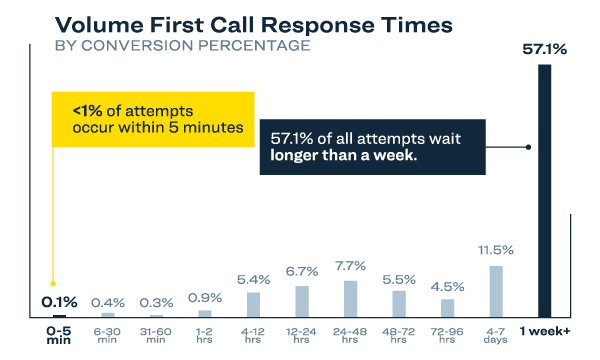
But what’s amazing is that of all the leads worked (and not many were; more on that below), less than 1% were attempted within that ideal 0-5 minute range and fewer than 15% were attempted within the first day.
Instead of starting with more activity, focus on making your reps 8X more effective. Would that translate to more deals closed for you?
NOT ALL LEADS ARE CREATED EQUAL—DON’T TREAT THEM THE SAME
Our research showed another interesting trend: of the 5.7 million leads we reviewed above, only 23% of them ever received even a single contact attempt from a rep, which means 77% of leads never get touched, except by your marketing automation tool.
First, this suggests teams have embraced a counterproductive behavior of enrolling most, sometimes all, leads into email nurture campaigns, even though marketing automation is supposed to warm people up, not replace meaningful sales engagement from a rep. Sales-ready leads don’t need to be warmed up!
Second, we audited a few million closed-deals from several thousand companies to see if rep efforts were aligned to deals that actually closed. Reps were spending 297% more time chasing deals that never close vs deals that do. That means only about ⅓ of the deals we pursue are actually good. The same math applies to leads.
So if you only chase 23% of all available marketing leads, just ⅓ of that, or 7.6% of the total, are in the sweet spot. Taking it one step further, of the 77% of all available leads your reps ignore, ⅓ of that, or 25.6% of the total, is actually worth your time.
Lastly, even though it’s 8X better to engage within 5 minutes, an astonishing 57.1% of all attempts occur outside of a week.
The takeaways here are:
- Teams leave way too much on the table
- There’s still too much guessing in sales
- Guide reps to engage sales-ready leads quickly, then let marketing automation nurture the rest until they’re ready to talk
BE PERSISTENT—YOU’RE IN SALES AFTER ALL
But how soon should sellers give up? It’s true you won’t connect with and convert every marketing lead within that optimal 5-minute window. But is one attempt really adequate? How about two, or three?
The reality is, after the first attempt to engage an inbound marketing lead, your efforts begin to mirror outbound engagement. Why not follow similar engagement best practices?
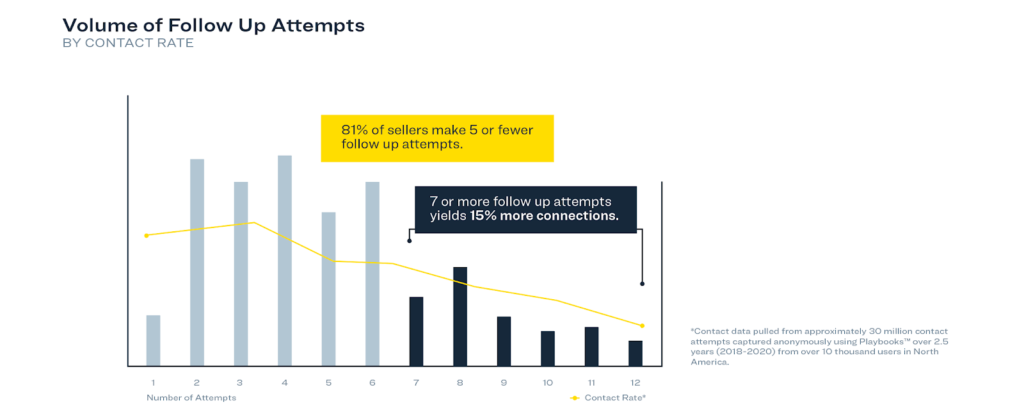
Generally speaking, reps think they’re a lot more persistent than they really are. The average number follow up attempts for outbound motions is around 1-2. With inbound motions, we’re a little better, but still 80% of our follow up activities on inbound marketing leads fall below 5 attempts; most sit around 2-3. And let’s not forget that 57.1% of first attempts don’t begin until after more than a week.
If you’re willing to strike early and you stick it out with 7 or more attempts, your connection rates will go up conservatively by 15%.
DON’T WAIT TO REFOCUS
Getting to buyers first has always been important. But it’s not just about getting there first anymore; it’s about getting there earlier enough to influence decisions. It’s about taking advantage of what marketing is doing to generate interested leads, and not allowing that interest to sizzle away.
COVID only made it more urgent. B2B buying and selling were already evolving when 2020 accelerated the transformation, but most teams were not ready. They were forced to adjust in ways that adversely affected marketing lead performance at each stage in the sales funnel. There has never been a more urgent time to align strategies to data.
What does this mean? Doing more isn’t the answer. And while speed-to-lead should be a tactical priority, it really comes down to aligning your strategies to data so that you’re able to do more of the right things and less of the wrong things. Playbooks can help you do it now.
____________
Data for this research came from an analysis of over 55 million sales interactions at 400+ companies across 5.7 million inbound marketing leads over a 3-year period, and from user outbound activity and outcome data on Playbooks over a 2.5-year period.
The post appeared first on XANT.